We’re seeing a global trend. Fewer babies. Declining fertility rates. Increasing pressure on care systems. And while it might sound like a distant demographic issue, it’s more urgent and personal than most people realise.
Birth rates don’t fall because people stop wanting children.
They fall because society stops making it possible.
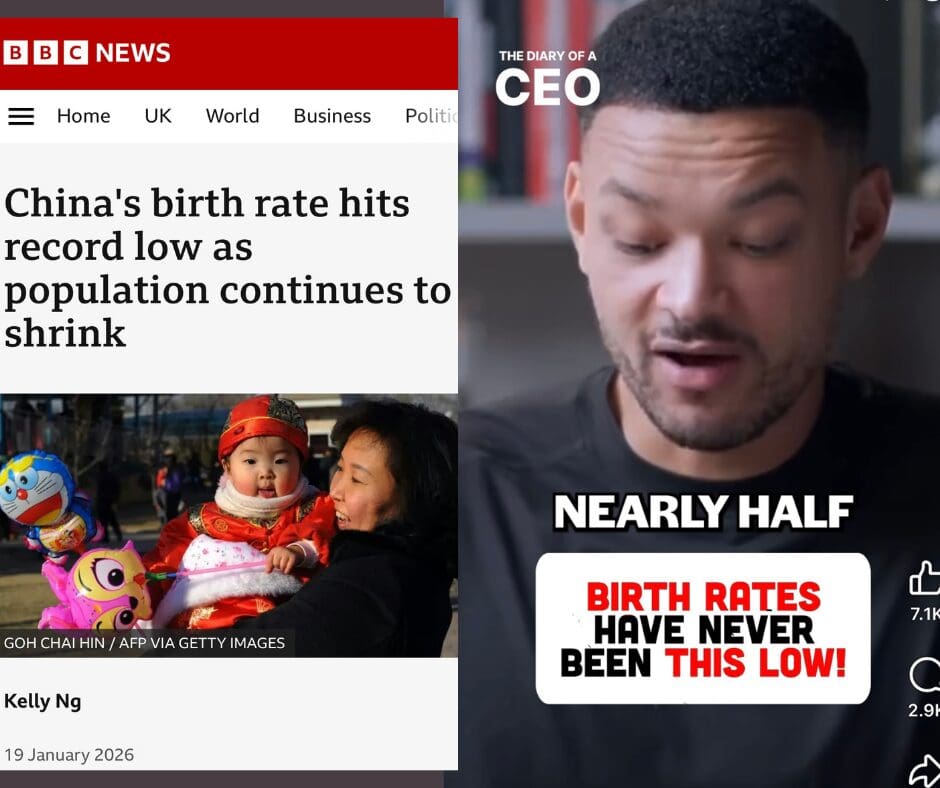
And yet somehow, in the middle of all this, we’re still giving airtime to podcasts like Diary of a CEO, where women’s education and freedom are framed as the problem. Steven Bartlett recently sat down with another man to discuss falling birth rates, and between them, they concluded that women having too much choice might be to blame.
No mention of unaffordable childcare.
No mention of parental burnout.
No mention of the mental and physical toll of raising a family without support.
Just vague suggestions that maybe women need to start partnering up so men can have children. As if the real problem is just that men aren’t getting enough chances to procreate.
It would be laughable if it weren’t so dangerous.
Here in the UK, birth rates are falling fast. But before we shrug it off as inevitable, or even desirable, it’s worth asking a better question. What happens when people don’t feel safe, supported or able to raise a family?
If we want answers, we don’t need to look far. China is already living the consequences, and the data is staggering.
The numbers are clear.
In 2025, China recorded just 7.92 million births, down from 9.54 million in 2024. At the same time, deaths rose to 11.31 million. The birth rate fell to 5.63 per 1,000 people, the lowest since the founding of the People’s Republic. The population is shrinking fast, ageing even faster, and despite everything the government has tried, it’s only getting worse.
And they’ve tried almost everything — or at least everything that treats the symptoms instead of the cause.
Since scrapping the one-child policy in 2016 and lifting all limits by 2021, China has rolled out cash incentives, baby bonuses, subsidised housing, extended maternity leave, and even controversial taxes on contraception.
In some provinces, officials have been encouraged to track menstrual cycles, discourage medically unnecessary abortions, and promote childbirth as a patriotic duty. Contraceptives like condoms and birth control pills were hit with a 13% tax. Matchmakers are being paid to get people married. And yet most young people aren’t biting.
Because the issue isn’t just about policy. It’s about trust. About support. About reality.
Young people are facing high youth unemployment, a slowing economy, unaffordable childcare, a property crisis, and social systems that just don’t work. Many don’t want to get married, never mind have children. One matchmaker in Beijing put it simply: “You can really feel that the number of people in Beijing who actually want to get married is shrinking.”
It’s not laziness or selfishness. It’s structural. And when the structure is broken, no amount of incentives will fix it.
And while China’s situation might seem extreme, the forces behind it aren’t unique.
The UK is heading the same way. Our population is ageing. Our birth rate is dropping. Our care systems are already stretched. And yet we’re still relying on outdated expectations of parenting, work and family life that don’t match reality.
We expect people to raise children while managing unaffordable childcare, inflexible working hours, chronic sleep deprivation and workplaces that don’t support families. We delay support until people hit burnout. We underfund preventative health. And then we act surprised when people choose not to have children at all.
This isn’t about panic. It’s about prevention.
It’s not about forcing people to have children. It’s about creating the conditions that help people choose to parent, and to thrive while doing it.
That means affordable childcare.
True gender equity in parental leave.
Workplaces that support care, not just output.
Mental health support for both parents.
And yes, a society that understands how critical sleep is to everything else.
Because when sleep collapses, everything else becomes harder.
Mental health. Relationships. Work. Caregiving.
And when those foundations erode, so does the desire or capacity to raise a family.
Sleep isn’t a side issue. It’s the root system that holds people together.
What I’m building is a preventative sleep health infrastructure. Not just for new parents, but for everyone. Something that supports families before they break. Because by the time we’re talking about collapsing birth rates and economic panic, the damage is already done.
The warning signs are here. We don’t need to wait for another generation to burn out or opt out. We don’t need to bring children into systems that aren’t ready to support them.
We need to build systems that are.
Let’s stop repeating mistakes.
Let’s start building something better.
If you’re an investor interested in the future of digital health and preventative care, or a company committed to supporting the wellbeing of your people, I’d love to hear from you.
To explore sponsorship, partnerships or investment in this work, please get in touch:[email protected]